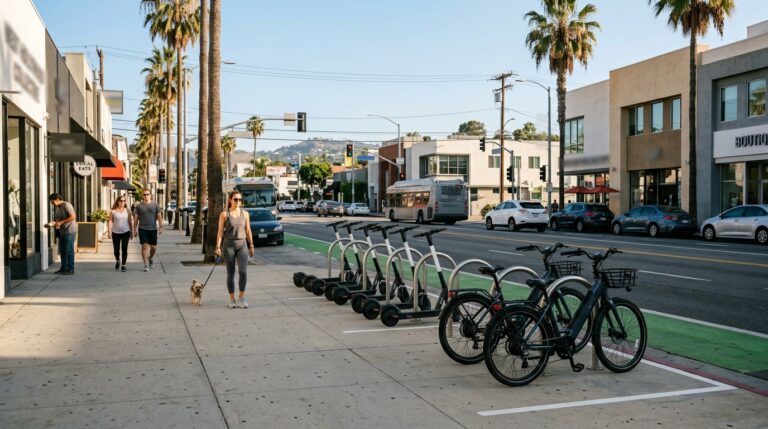
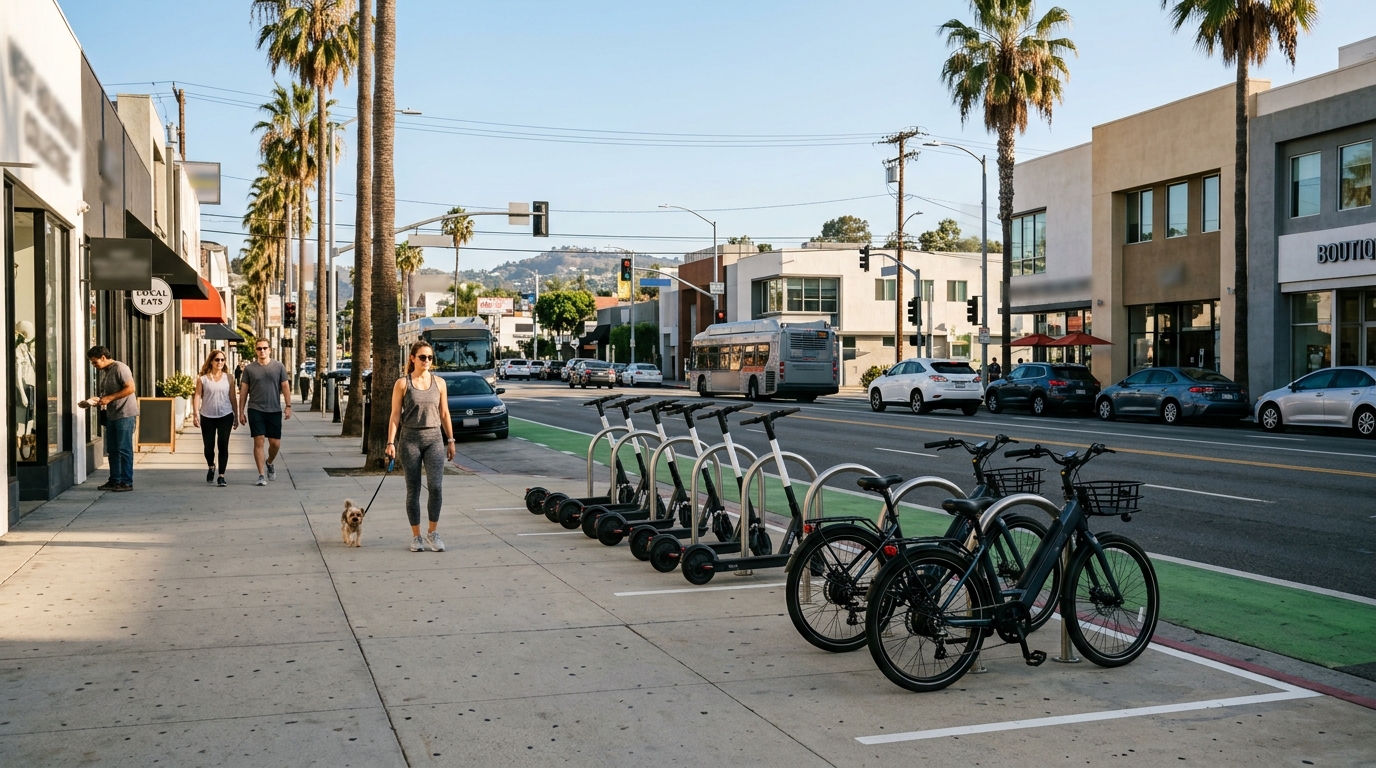
If you regularly use a shared e-bike or e-scooter to move around West Hollywood, there is an important new rule to know before your next ride. Beginning August 7, 2026, riders using dockless mobility devices in West Hollywood must park them in designated virtual parking locations before ending their trips.
The change is particularly relevant to Lime users. Approved parking areas now appear within the Lime app, and riders cannot complete a trip unless the device is left in one of those designated locations.
West Hollywood followed the rollout with a citywide education and enforcement effort involving the Los Angeles County Sheriff’s Department on August 12. Officials emphasized rider education and warnings, but citations may also be issued for unsafe riding or improper parking.
The new system is designed to address a common problem with dockless transportation: scooters and e-bikes left across sidewalks, curb ramps, driveways, building entrances, and other spaces people need to move through safely. Here is what riders, residents, and visitors should understand about the 2026 changes.
What Changed for Dockless E-Bikes and E-Scooters in West Hollywood
The biggest change is simple: shared dockless devices can no longer be left virtually anywhere at the end of a trip. Riders must use specific parking locations selected by the City of West Hollywood and displayed within the Lime app.
The rule applies to dockless shared mobility devices. The City’s current announcement specifically identifies Lime riders and Lime e-bikes and e-scooters, so riders should not confuse the new shared-device parking system with rules for every privately owned bicycle or e-bike.
Virtual Parking Zones Are Now Required
A virtual parking zone is different from a traditional bike rack or physical docking station. Instead of locking every scooter into a piece of fixed infrastructure, the Lime app identifies approved areas where devices may be left.
When a rider reaches a destination, the app determines whether the device is within an approved parking location. According to the City, a Lime trip cannot be completed unless the device is parked in one of these designated zones.
That means riders should check the app before reaching their final destination. If the closest approved zone is a short distance away, you may need to continue there rather than leaving the scooter directly outside a restaurant, shop, apartment building, or event.
Why West Hollywood Changed the Parking System
The goal is to keep shared mobility useful without making sidewalks harder to navigate. West Hollywood’s streets have heavy pedestrian activity, restaurants with outdoor traffic, transit stops, apartment entrances, nightlife destinations, and visitors moving between businesses throughout the day.
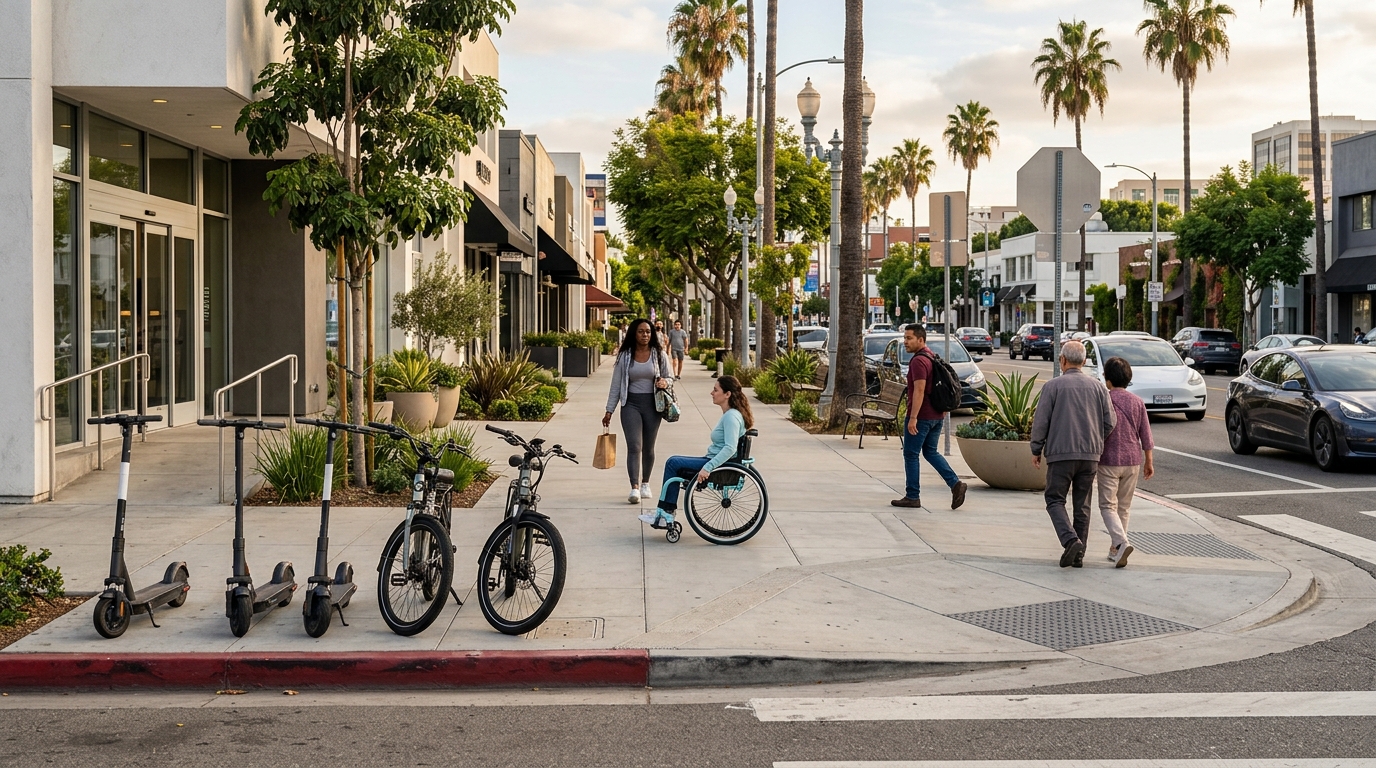
A scooter left across a sidewalk may look like a minor inconvenience, but it can become a significant obstacle for someone using a wheelchair, walker, stroller, or other mobility aid. It can also block curb ramps that provide essential street access.
The City says designated parking areas were selected based on available sidewalk space so that shared devices and pedestrian access can coexist more safely.
Parking in a Zone Does Not Mean Blocking the Sidewalk
Reaching the correct virtual zone is only part of responsible parking. The City also instructs riders to leave devices upright and positioned so they do not obstruct sidewalks, curb ramps, driveways, transit stops, building entrances, or pedestrian travel.
In other words, do not simply drop a scooter on the ground because the app says you are inside an approved area. Take a few seconds to position it neatly and check that someone can comfortably pass.
This is especially important on busy corridors such as Santa Monica Boulevard and around restaurants, nightlife venues, parks, and shopping areas. If you are exploring the city without a car, our Welcome to WeHo Directory can help you group destinations together and avoid unnecessary trips across town.
Enforcement Is Becoming More Visible
The August parking change was quickly followed by a high-visibility education and enforcement effort involving Los Angeles County Sheriff’s deputies. The operation took place throughout West Hollywood on August 12 and focused on both safe riding and proper parking.
The City said warnings and education would be emphasized during the operation, although citations could be issued for violations. That is an important distinction for riders who have become accustomed to treating scooters as casual sidewalk transportation.
Shared mobility devices may be easy to rent, but using one still comes with responsibilities. Riders are operating in an environment shared with drivers, cyclists, pedestrians, transit users, and people entering or leaving businesses.
The Rules Apply From the Start of the Ride to the End
Proper parking should not be the only safety consideration. California DMV guidance for motorized scooters says they should not be ridden on sidewalks, are limited to 15 mph, and require riders to meet applicable licensing requirements. Riders should always check current state and local requirements because e-bike and e-scooter rules are not necessarily identical.
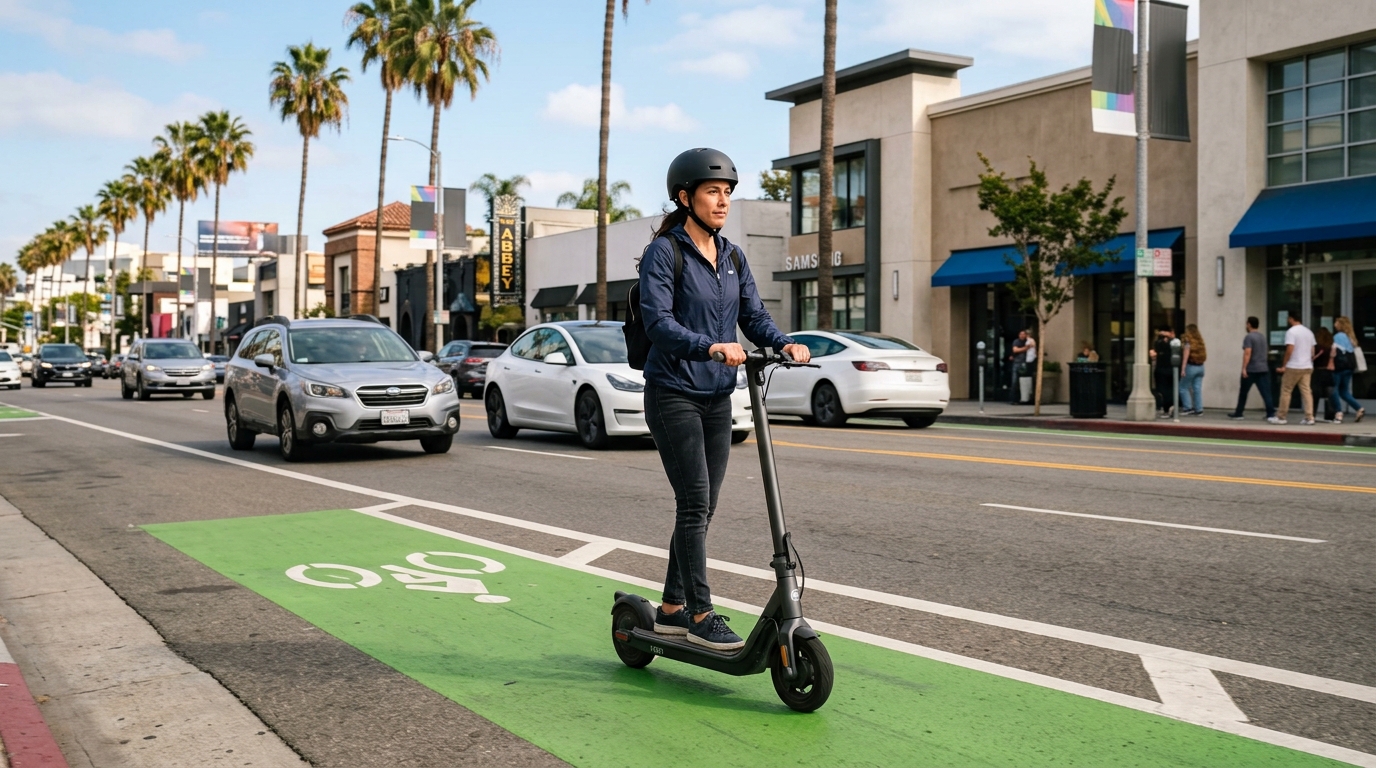
In West Hollywood, bicycle lanes and other mobility improvements provide places where riders can travel more predictably than weaving through pedestrians. During National Bike Month in May 2026, the City also highlighted Lime’s e-bike-share program and provided opportunities for the public to learn about and demo Class I pedal-assist e-bikes.
Before riding, look at the route rather than relying only on the shortest path shown by an app. A slightly longer street with useful bicycle infrastructure may be more comfortable than a busy corridor with complicated intersections.
How to Use Shared E-Bikes and Scooters More Easily in WeHo
The new parking system does not make dockless transportation unusable. It simply changes how riders should plan the final few minutes of a trip. With a little preparation, an e-bike or scooter can still be a practical way to cover short distances around West Hollywood.
This matters in a compact city where many destinations sit relatively close together but may still feel too far apart for a quick walk, especially in hot weather or when visitors are moving between several neighborhoods in one day.
Plan Around Parking Before You Start Riding
The easiest strategy is to look at available parking zones in the Lime app before setting off. Do not wait until you are standing outside your destination to discover that the nearest approved area is somewhere else.
If you are heading to dinner, a park, the Sunset Strip, a shopping area, or an event, identify an approved parking location nearby and treat that point as the actual end of your ride.
A simple shared-mobility routine can look like this:
- Open the app and check your destination before unlocking a device.
- Review the available approved parking zones near where you are going.
- Choose a route that keeps you off pedestrian sidewalks.
- Use marked bicycle infrastructure where appropriate and available.
- Slow down around intersections, driveways, and areas with heavy foot traffic.
- End your ride inside a designated virtual parking location.
- Leave the device upright and confirm it is not blocking pedestrian access.
Think of E-Bikes and Scooters as Part of a Car-Free WeHo Day
Shared mobility works best when it is one tool among several rather than the only way to move around. A visitor might walk between nearby restaurants and shops, use an e-bike for a longer stretch, then connect with transit or another transportation option later in the day.
For example, you could explore sections of Santa Monica Boulevard connected to historic Route 66 and use a shared bike to shorten the distance between stops. Our West Hollywood Route 66 Centennial guide has more ideas for experiencing that corridor.
If you are heading toward green space or simply want a break from busy commercial streets, explore our Parks & Outdoor section. Riders heading toward evening destinations can also use our guide to what’s new on the Sunset Strip in 2026 to plan stops before deciding where a shared ride makes sense.
The City is also continuing to evaluate the dockless mobility program and identify additional parking areas. Community members can suggest potential locations through the Engage WeHo portal, and City staff will review them for accessibility impacts before deciding whether to add a new zone.
Residents who see an improperly parked or abandoned dockless e-bike or e-scooter can report the issue through West Hollywood’s service-request system or the official City app.
Parking information
For current rules, parking information, enforcement updates, and reporting options, visit the City of West Hollywood’s official dockless mobility update.
The August 2026 changes are a reminder that shared mobility has entered a more mature phase in West Hollywood. The conversation is no longer simply about whether scooters and e-bikes should be available. The challenge now is making them work alongside pedestrians, businesses, transit, cars, cyclists, and residents in a dense urban environment.
For riders, the new rule is straightforward: check the app, use an approved parking location, leave the device upright, and keep the public walkway clear. Planning those final few minutes of a trip can prevent frustration and help keep shared transportation available without creating unnecessary obstacles.
West Hollywood remains a city where many daily trips can be made without a car. Walking, cycling, transit, e-bikes, and scooters can all be part of that mix. The better riders understand where and how to use them, the easier it becomes for everyone to share the street.